


Hillary Do is the Founder and Executive Director of BOLT, a Philadelphia-based organization that supports grassroots leaders to drive community-led change. BOLT has two core programs that advance this work: a School for Grassroots Leadership and a Youth Leaders Fellowship. The former is a capacity-building program focused on accelerating the work of Philly’s neighborhood leaders “who show up for their communities every day,” while the latter is about cultivating Philly’s grassroots leaders of the future.
I first met Hillary when we were at Stanford together, and I’ve been genuinely impressed by her continued commitment to particular, local work after leaving a place that was all about scale, scale, scale. Now that she’s four years into building BOLT, I wanted to check in with her about how this intentional community-driven work is going. We covered a lot of ground in this conversation, including:
Why it’s important for BOLT to be working with both student leaders and adult grassroots leaders
How Hillary thinks about scale as going deep within a place rather than expanding across many places
Why centering “proximate” leaders matters for the commitment, durability, and accountability of social change work
What positive ripple effects have already emerged as a result of BOLT’s local and neighborhood-level work in Philly
As I observed during our conversation, BOLT occupies an important (and, at times, tenuous) middle ground between grassroots leaders and existing systems of power — and I really appreciate how Hillary talks about holding these tensions.
Please consider giving the full Q&A a read. And, if you’d like to learn more about BOLT’s work, you can check out their website, follow their Instagram, and join their email list.
- Sam
PS: A special thanks to Margo Miller for her support with this Q&A.
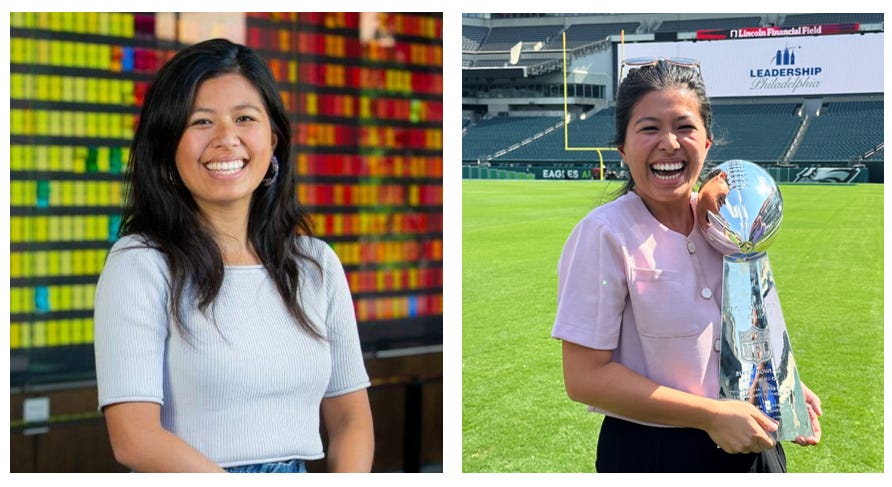
Sam: I find it fascinating that you started Philly BOLT — which is all about the hyperlocal and hyper-proximate — while we were at Stanford’s business school, which, from my experience, was all about scale, scale, scale divorced from place.
So, what led you to create Philly BOLT — with its focus on particular grassroots leaders in particular Philly neighborhoods? And how did you navigate starting it while in a place that is seemingly worlds away from Philadelphia?
Hillary: I have a background in community organizing and city government. I also explored civic technology, which is all about scale. I worked for Google’s Civic Tech team and I worked for Brigade, a startup that came out of the first 10 Facebook apps. I understood why they wanted to focus on scale, but I didn't see the impact that they were talking about. When we actually organized, had in-person conversations, and got to know people — that’s when we started to address what people needed.
Stanford was helpful in many different ways. But there was a lot of pressure to focus on scale. For example, when I applied for the Stanford Impact Founder Fellowship, my application was very focused on organizing, in-person conversations, and building relationships. And one piece of feedback I got from the first round of interviews was, “Why not make a tech app to solve this?” There was certainly a mountain to climb when it came to those spaces.
While I was at Stanford, I also did an internship for Chicago CRED, which is a deeply place-based organization in Chicago. I saw the impact they had in investing in credible messengers, investing in people at the neighborhood level, and cultivating relationships. I thought, “If this works in Chicago, then why not pursue it in Philly?”
I'm very connected to Philly. Both my parents immigrated to Philly when they got to America, and Philly has always been home (Go Birds). There are incredible people in the city doing really great work. And I fundamentally believe that a lot of nonprofits like ours shouldn't exist in the first place. With BOLT, I wanted to figure out something that will actually address a problem — where we can put ourselves out of a job at the end of the day.
This starts with supporting leaders at the community and neighborhood level, training them to support others, connecting young people to them, and integrating directly into the public education system. If we support people in their leadership journeys who are proximate to their neighbors, then they can support their neighbors to step up, too. Then they will not have to rely on external stakeholders for resources. That's what we're working towards — putting ourselves out of a job by strengthening communities from the ground up.
Centering these “grassroots” leaders seems to be essential to your work, but I know that term gets thrown around a lot. What does “grassroots” mean within your work?
We define “grassroots” as people who live in the neighborhoods: people who send their kids to school there, people who walk the streets there, people who breathe the air there, people who are most proximate. I've been having conversations with funders and larger institutional nonprofits, and they’re saying, “All right, we gotta think about closing our doors because we don't have funding.” But what's struck me about the leaders we work with at BOLT is that there’s no “closing the doors” for them. Because they live in the neighborhoods they serve, they don’t close their laptops, lock up an office, and sign off at 5PM. They know what’s at stake because they experience it too – they live here.
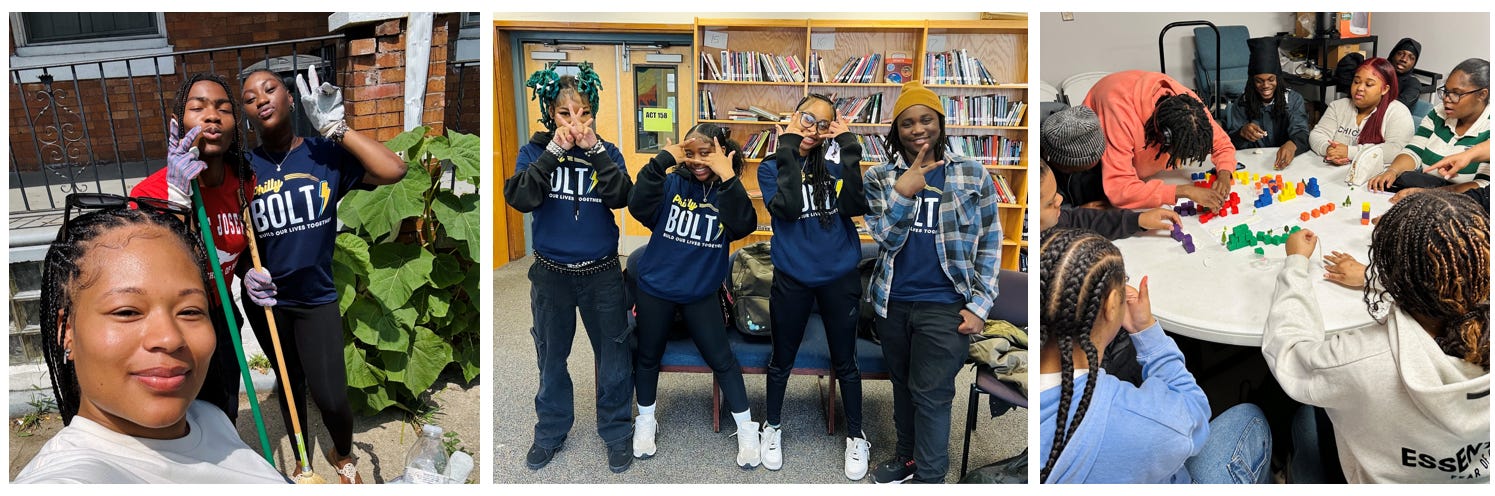
This gets into what y’all actually do at BOLT. So how would you begin to describe BOLT’s two core programs: the BOLT School for Grassroots Leadership and the Youth Leaders Fellowship?
The BOLT School for Grassroots Leadership is a program for adult community leaders who live in the neighborhoods they serve. Despite having immense impact, they are oftentimes paying out of pocket or taking up multiple jobs to support their neighbors. We support them in an eight month capacity-building program, which leaders attend three hours every Saturday. We do everything from community building within the program to teaching about fundraising, budget-building, accessing fiscal sponsorship, hiring, and more. We also connect them to the local resource ecosystem outside of BOLT.
Our Youth Leaders Fellowship is a year-round program, split between the academic year and summer, focused on Philadelphia public high school students, especially those in neighborhood, catchment-based schools. This summer, we'll have 60 young people doing paid internships with us, learning about how to bring change in Philadelphia, developing socio-emotional skills, and gaining career experience. During the academic year, we train 10-15 young people at each of our partner schools to guide their peers in a Community Action Project.
Both programs are built on a train-the-trainer, peer-to-peer model. People are already doing the work in their neighborhoods to support their communities; our job is to help them “level up” so they can accelerate their work.
Can you share a little bit more about the “BOLT Ecosystem,” as you call it? How do you think about the relationship between the grassroots leadership school and the youth fellowship?
We want this to be intergenerational work: Working with young people and adults is so critical to what we’re doing. It’s important for young people to know who the adults are in their neighborhood doing this community-building work. These grassroots leaders have neighborhood programs the students can participate in. Some have physical buildings that can provide a safe space for students to connect with others. They may have potential job opportunities for students. They can become mentors to students who live in the neighborhood. They are also role models who can help show our students what’s possible.
For example, Mecca, a young person who has participated in our program for a few years, wants to open up an arts rec center one day. She talks about how our program helped her see how people from her neighborhood were able to build something from scratch that is community driven. She now knows she can do that too. She knows what resources exist, and that BOLT and our partners are going to be there to support her.
In terms of the larger ecosystem, we're also connecting to government, funders, social impact consultants, and more. We bring our youth fellows to City Hall and connect them with elected officials, so they know how government operates and how to access it. Most of our youth fellows have never been to City Hall, don’t know where it is, and have never spoken with an elected official before our program. Following the program, many note that they were surprised they could talk to elected officials directly and share what they think. For the community leaders we work with, connecting with funders has opened up additional streams of financial support, while demonstrating to funders that these are the leaders on the frontlines of change in the city. We’ve also introduced our leaders to consultants, who have done everything from offering free coaching sessions to inviting them to various nonprofit conferences. This expands the network of the leaders in our program, so they are not relying on BOLT in any way.
Why are people joining the Grassroots Leadership School? Can you share some examples of the types of leaders who join?
We are about creating community. We don’t call the leaders “clients”; they are family. The leaders in our program — both youth and adults — refer to our program as the “BOLT family.” What we’re finding is our community provides social support that is practical and immediate.
For example, Ron, who runs Ordinarie Heroes in North Philly and was in the second cohort, has this great community space. One of the leaders in the third cohort, Danni, who leads Diamond Beauty Academy, was looking for a temporary space to host some of her programming before she got a space of her own. So we connected her with Ron, and she ended up running her cosmetology program for young women in Philly out of Ron's space.
Another example involved Cleo, who leads A Home from Shana Foundation and was in our first cohort. She had a broken window in her building and was asking for support to fix it. Ryan was in the first cohort with her (he leads As I Plant This Seed), so he asked his thousands of followers on Instagram, “Can somebody help repair this window?” And they got it repaired right away.
The other reason leaders join is for the technical assistance. One of the leaders in our first cohort does healing circles for families who have lost children to gun violence — every week, she creates space for about 50 individuals to support each other. But a lot of the members didn't feel comfortable taking public transportation after losing someone to gun violence, so to help them make it to the program, she was paying for their Ubers out of pocket. She had a donor offer to fund the work directly, but this funder said, “I can't give you funding unless you have a fiscal sponsor or 501(c)3 status.” We helped her get a fiscal sponsor, and now she’s able to secure more funding opportunities like that.
It strikes me that you’re in this middle ground as an intermediary between grassroots leaders and existing systems of power, such as philanthropy and government. So I’m curious how you relate to the grassroots leaders and the existing systems, respectively?
I want to emphasize that people are already doing the work. What we add is not the creation of leaders, or the creation of the work that needs to be done, or even a creation of this community. What we do is support and accelerate the work — amplifying the impact, essentially.
I remember having a conversation with a funder who was very interested in our BOLT School for Grassroots Leadership, but then they said, “This program sounds fantastic, but Hillary, do you actually think you're going to find leaders in these neighborhoods? Maybe start with people of color who live in the suburbs but are working in Philadelphia.” It’s been really important to push back against this idea that there aren’t leaders in these neighborhoods. It’s been really important to show that these communities are full of people who are actively working to make their neighborhoods better.
Within the system, there are people who are trying to change it and understand how to do this work in a values-driven way. And, yes, some of these systems — philanthropy, the government — are unjust. It's complicated and difficult, but I don't think we should shy away from it. In the organizing world, people will say things like, “Let’s work outside these systems.” But you can’t work outside the system in a way that starves people. Sometimes the loudest voices want to do this work in a way that doesn't recognize the day-to-day realities of people who are experiencing poverty. It's easy to use fancy words or talk about doing the work in an uncompromising way. But when you are experiencing poverty and you don't know if you're going to have enough diapers for your newborn, you have to live with and directly confront these realities.
This is starting to get at this idea I’ve written about: You can’t have “solidarity without proximity.” And it sounds like you’re seeing people trying to speak or act on behalf of neighborhoods without having any skin in the game in those neighborhoods.
In many instances, the people who are the loudest voices about bringing change are not the ones who are actually reflective of the neighborhoods that they're talking about. These people will say, “I'm advocating for all this change on behalf of working-class people in Philadelphia.” And people in the neighborhoods are like, “Who is this person? I don't know who this person is.” That's a huge problem in my opinion. If we really want to talk about doing this work in a way that centers the people who are most proximate, it's got to be at the neighborhood level. It's about amplifying those voices and elevating their platform.
For instance, there are a lot of loud voices talking about how to address gun violence in Philadelphia, but they are not necessarily aligning with community-driven strategies. If someone comes in talking about how they want to fix gun violence in Philadelphia and they don't know who Ryan Harris, Rickey Duncan, Aigner Bostic, Ant Brown, Mazzie Casher, and the other Philly leaders are, how can it be community-driven? These are some of the most prominent leaders in the neighborhoods facing the highest rates of gun violence — on a day-to-day basis, they are building relationships, intervening and interrupting potential violence, sometimes even putting their lives on the line. If they're not part of the conversation, and you don't even know who they are, that's a problem.
One thing you’re getting at — throughout this interview, but especially in that last response — is how living in a place creates both commitment and accountability.
Accountability and commitment is a huge part of it. This is where we live — there’s no closing of the laptop and going home — so we're very much accountable to the people around us. There is a great quote from Valencia of ODAAP (Open Door Abuse and Awareness). She says something along the lines of: Our communities don’t need “drive-by solutions”; what our communities need are solutions where people are being invited in for dinner — where we're having conversations and building relationships.
You’ve already committed four years of your life to build BOLT, and I know you have a lot of data on your impact that you’ve published. How would you begin to describe what’s actually happened as a result of BOLT’s work in Philly? Has any of this been surprising or unexpected?
There are a lot of specific data points in our impact reports. Overall, a few big things are happening.
I’ll start with some of what I shared earlier. Young people like Mecca can see that people from her neighborhood are able to build something from the ground up and know what resources exist. It’s inspiring more people to be able to do this work. For the grassroots leaders, we’re accelerating their work by helping them access more fundraising opportunities, grow their teams better, and understand some of the technical pieces of running their organizations.
But there have also been other unexpected effects. For instance, we're seeing that the young people who participate in BOLT have a higher school attendance rate than the average in the school district. For some of the schools we work with, attendance is a huge challenge. These young people are like, “I'm gonna show up, because I really like BOLT and I like being in the space where I am heard, and I feel like I can make a change.”
More funders are starting to get what we’re doing, and elected officials are starting to see it, too. There’s been more acknowledgement: These are hundreds of young people who are going to be voters one day, and their parents are voters, too. The community leaders we support have thousands of followers on Instagram and huge pull in their neighborhoods. Elected officials realize they should be listening to them, recognizing the work that they're doing, and connecting with them.
It seems like you’re just getting started.
I believe in the power of people. I know it sounds corny, but people start to pay attention when a lot of people start to organize.