

Civic (Re)Alignment
How we can rebuild the positive feedback loop between membership, revenue, and governance — both within our organizations and across our communities.


From Diminished Democracy, by Theda Skocpol:
“Touted as spontaneous and entirely bottom-up, many of today’s ‘community organizations’ or ‘grassroots’ undertakings are not quite what they seem. Sparked by well-connected leaders, they frequently have—or soon obtain—outside funding from tax-exempt private foundations … we should not imagine that [this] is a fully democratic arrangement … today’s supralocal institutions are not accountable, and [their] leaders are not elected. As professional experts and managers, foundation people rarely arrive at their positions by working from within the groups they supervise. And the moneys they dispense come not from membership dues but wealthy donors who receive indirect tax subsidies from all Americans, subsidies not accompanied by popular oversight or even much understanding of what is at stake” (p. 228-230).
When I was with the Armed Services Arts Partnership (ASAP), I would half-jokingly remark that I ran two businesses. The first was a programs business of community arts classes, workshops, and performances with veterans and their families. The second was a fundraising business of courting grantmakers, corporations, and private donors. I would spend 80 percent of my time chasing funders and recruiting board members, and these board members would, in turn, help me chase more funders. These were, functionally, two separate worlds: Rarely, if ever, would our community members meet our funders, and rarely, if ever, would our funders experience our actual classes and workshops (despite my countless invitations for them to join).
I’d go to therapy a lot in those days (I don’t go now because I have a Substack) — and our sessions often devolved into me blabbering about how misaligned I felt. I was spending most of my time on something that had nothing to do with why I started the organization. Worse yet, I found myself caught in the position of middleman, attempting to authentically represent the complicated, human experiences of the veterans in our community to a funder audience often looking for victimizing trauma porn, overly simplified measurable outcomes, or both. I eventually decided to leave, in part, because this feeling of misalignment had become so great.
In hindsight, I made the mistake of deciding what I’d create without considering how I’d create it. By not asking first principles questions about alignment — and, particularly, how our business and governance models could facilitate alignment — I ended up inadvertently building a typical nonprofit, where I was as much beholden to the fleeting whims of outside funders as I was to the genuine needs of ASAP’s community members.
This experience taught me an essential truth: More than anything, it is the business models we develop, the funding sources we take on, and the governance and ownership structures we establish that dictate what our organizations will become. Before we decide what we create, we must decide how we’ll create it.

If I’m practicing ~self-care~, I can recognize that my personal misalignment within ASAP was part and parcel of an accelerating misalignment within civic life since the 1960s. As academics like Theda Skocpol and practitioners like Sara Horowitz have thoroughly documented, the proliferation of nonprofits dependent upon philanthropic and government funding sources — and driven by board members who can get access to those funding sources — has severed the alignment between revenue, governance, and membership, both within organizations and across our communities. The result: entire civic ecosystems that are less resilient to outside shocks, less democratically controlled, and less responsive to their members’ needs.
I’ve been writing a lot these days about our “generational moment” of civic renewal. But if we’re truly going to cultivate a renewed civic life, we must cultivate a more aligned civic life. And this alignment must be anchored on a vision for self-sustainability and self-governance, where members are central to revenue generation and decision-making.
Envisioning a virtuous cycle of civic alignment
“Cash rules everything around me … get the money, dollar, dollar bill, y’all.” - Wu Tang Clan
“Trust your own judgment. Live with it and love it.” - Nas
Civic alignment is built on a positive feedback loop between membership, revenue, and governance. Our civic lives can be seen, not as one membership, but many memberships: We exist in overlapping webs of neighborly, communal, religious, and municipal association. When civic life is in a virtuous cycle, the groups exist for the benefit of their members, the members contribute the foundational source of revenue for the groups, and the members decide on each group’s direction. These virtuous cycles can be realized both independently — within particular groups doing their thing — and interdependently, throughout entire civic ecosystems.
This involves a fundamentally different orientation than contemporary nonprofits, which often begin with two assumptions. First, grants and donations should be their main funding source. Second, governing boards should primarily help them access these philanthropic resources.
In contrast, civically aligned groups commit to self-sustainability, where their membership and core activities power their business models. Rather than immediately looking for outside resources to fund their work, their starting question is: “How can we build a business model to make our work durable?” They may commit to collecting member dues and fees. They may commit to developing additional revenue streams that are in service of their members’ needs or desires. And while they may draw on outside funding at times, they do it on their own terms — and they certainly do not rely on it.
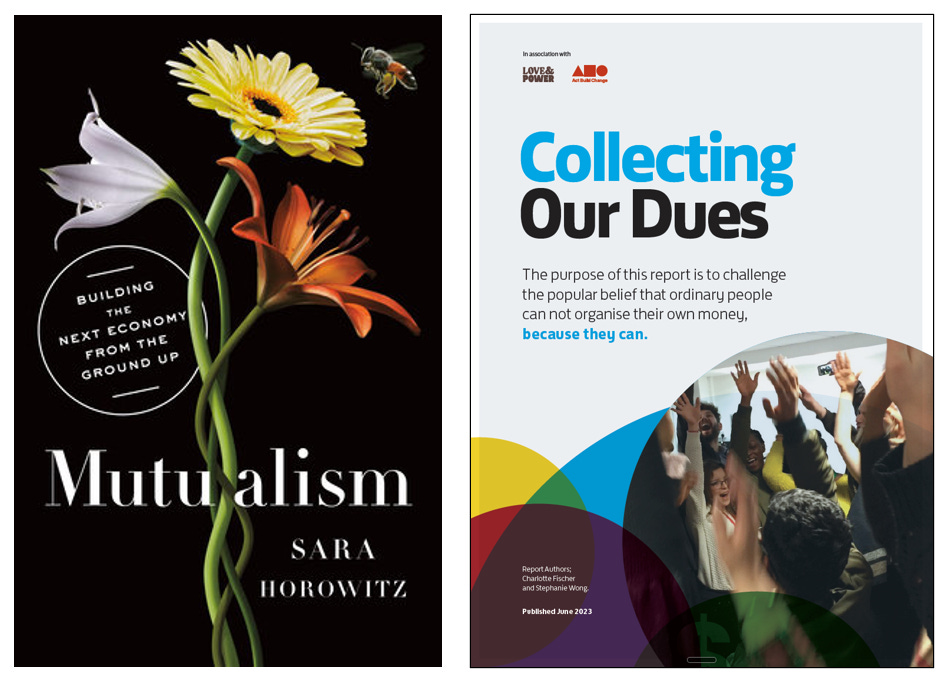
Writing in her book Mutualism, Sara Horowitz describes how she developed this type of self-sustaining business model for what is now the Freelancer’s Union:
“We put a provision into our earliest 501(c)3 nonprofit filing for Working Today saying that we would be providing insurance to model a new kind of portable benefits system, and we eventually settled on a brokerage model … Brokering insurance is a tried-and-true business model, but in our case we weren’t trying to make money from it. Instead, we were using it as an economic mechanism to fund our nonprofit. Since brokerages are required by regulators to be for-profit businesses, we created a new insurance brokerage business just to serve freelancers. It was a for-profit, wholly owned by the nonprofit, ensuring that no money left our little ecosystem …” (p. 101).
This type of mutualistic, self-sustaining model becomes a forcing function toward alignment, driving members and leaders alike to advocate for self-governance. When members have skin in the game economically, they are far more likely to believe they deserve a say in the decision-making and future direction of the group. And when leaders depend on members as a core source of revenue, they are far more likely to prioritize members’ perspectives across all facets of the group’s decision-making.
Charlotte Fischer and Stephanie Wong punctuate this point in Collecting our Dues, their 2023 report on the role of funding in civic organizing:
“[Organizing] our own money is not just for cash flow. It is so much more than that. It creates new opportunities to create a culture and infrastructure that can lead to winning transformative change owned by the people who have the biggest stake in its future” (p. 6, emphasis added).
While there is not one “right” way to do self-governance, there are some shared practices that underpin civically aligned governance models. Often, this starts with a first principle: Power should emerge from the members, not management or outside stakeholders. Formally and foundationally, this looks like giving members actual voting roles on the governing bodies of the organization. These governing bodies often have several entry points for member participation — participatory and accessible committees and meetings, for instance — and members receive clear guidance on how they can deepen their participation. When decisions are delegated to management or a subgroup of members, there is a clear process for what decisions are delegated and who can make decisions on behalf of the group.
Perhaps you’re reading this and thinking: “achieving civic alignment sounds way easier said than done.” And I can imagine the ideals of self-sustainability and self-governance sounding naively slow-going, especially as we’re inundated with calls to “act now” in the face of [insert crisis here]. I mean, it does take time to build a member-driven business model, and it is not efficient to involve members in decision-making.
But us people are slow and messy, and durable change is not quickly won. Our civic life will not be renewed with the quick fix dopamine hits of philanthropy-driven civic managerialism. If we want a revitalized civic life that centers us people as democratic members, we’ll need to embrace the slow, messy work of civic alignment. And we’ll need to commit to this work as a generational project — both drawing on the lessons from past generations and imagining possibilities for future ones.
Recovering lost practices, creating new possibilities
“I'm dead in the middle of two generations, I'm little bro and big bro all at once.” - J. Cole
Realizing this generational vision for civic alignment must start with a commitment to recovering what’s been lost.
Throughout much of American history, alignment was the norm, not the exception. As Skocpol details throughout Diminished Democracy, it was federated, member-driven networks that built (and rebuilt) associational life in the U.S. from the Revolutionary War through the Civil Rights Era. In Mutualism, Horowitz painstakingly describes how self-sustaining, self-governing mutualist organizations — the International Ladies’ Garment Workers’ Union and the Amalgamated Clothing Workers of America, for instance — helped reweave the social safety net following the twin shocks of industrialization and mass immigration in the early 20th century. And, in our Connective Tissue Policy Framework, the civics scholar Peter Levine explained how self-sustaining business models powered the Civil Rights Movement: “All those Montgomery, AL, Black-led organizations were self-sufficient. They weren’t getting grants, they hadn’t shifted to a philanthropy-dominated model” (p. 34).
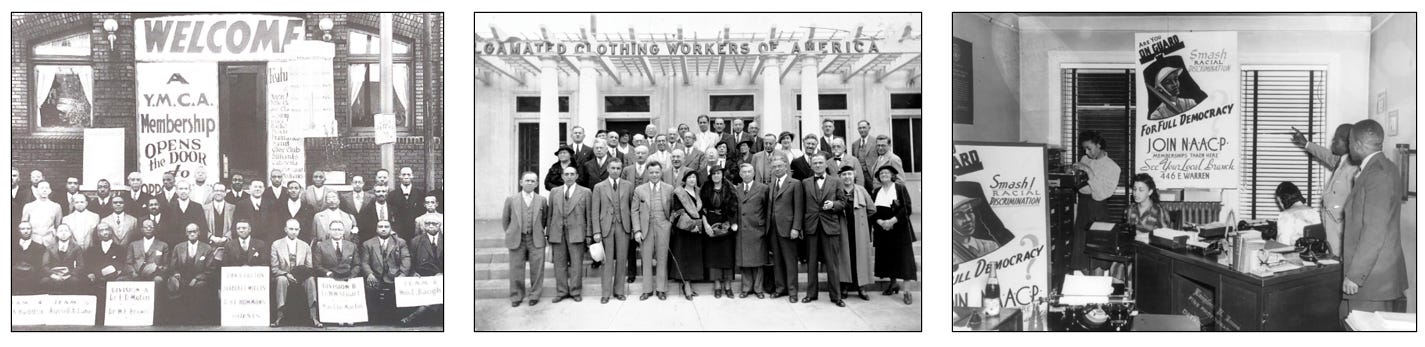
But today’s environment is materially different from that of the early to mid-20th century. It’s not just a story of how, as Skocpol writes, “The professionally managed organizations that dominate American civic life today are … less democratic and participatory than the pre-1960s membership federations they displaced” (p. 13). It’s also a story of labor, costs, and education. Women fully participate in the labor force now, and rightfully can’t provide the countless hours of free work that powered our civic groups of old. The costs of running a group today — land, labor, materials, and more — are, on relative terms, far higher today than in our more civically aligned eras. Plus, most of us have never learned the skills and practices of self-governing membership that were once taught through participation in voluntary groups, religious groups, and unions.
The Canadian political philosopher, Drake, once said, “Things change, people change, feelings change too. Never thought the circumstances woulda changed you.” But, Drake was wrong: The circumstances have changed us. So, if we’re going to create models for civic alignment, where do we begin?
We can start with our own individual intentions. This could look like asking a few first principles questions before we create our groups (or before we grow our groups to the next level). What type of business model do we want to power our work? What role do we want outside funders (philanthropic, private, or public) to play in our group’s development? And, what role do we want members to have in governance and decision-making? As simple as these questions sound, asking them at the outset — rather than assuming our groups will rely on philanthropic funding and outside board members from the jump — can make the difference between creating a civically aligned or misaligned group.
We also need to act collectively, both experimenting with and learning to cultivate more civically aligned models and practices. We need more incubators like Build IRL that are specifically focused on helping civic groups test out sustainable business models — both from a revenue and cost perspective. We need cohorts of civic groups committed to experimenting with more flexible forms (e.g., beyond the 501(c)3 nonprofit) and more member-driven governance structures. We need Highlander-style education programs that reclaim the function of voluntary organizations and unions of the past, training a new generation to build toward self-sustainability and self-governance. And we need bottom-up, federated networks of civic leaders — networks that are not mediated by philanthropy or government, but themselves model the self-sustainability and self-governance they want to see in their communities — to facilitate this experimentation, learning, and diffusion, both within and across place.
If all of this seems incipient to you, that’s because it is. But just one group with an aligned business and governance model can become a seed of possibility for an entire civic ecosystem.
Because our ideas, practices, and ways of being spread horizontally — improvisationally and memetically through networks — our little civic experiments can turn into emergent civic cultures. One civically aligned group soon spawns 10 more, and these 10 groups form a loose network that spawns 50 more. Slowly, then seemingly overnight, the emergent culture of alignment becomes the dominant culture of alignment in our civic ecosystems. As membership, self-sustainability, and self-governance become central, not just in one group, but in all groups, the virtuous cycle of civic life can begin anew.
Excellent piece, Sam. Couldn't agree more about the importance of this 'realignment'
Happy Juneteenth all! Great article, Sam! Thanks for sharing it!
I feel like the straightforward nature of the concept of aligning approach with clear principles often belies how profound of an impact it has. Its as if means and ends have to be coherent if the ends are meant to be lasting. I also appreciated the hip-hop references sprinkled in here!