

Re-blurring the lines between journalism and civic life
A Q&A with journalist, network-builder, and civic strategist, Darryl Holliday


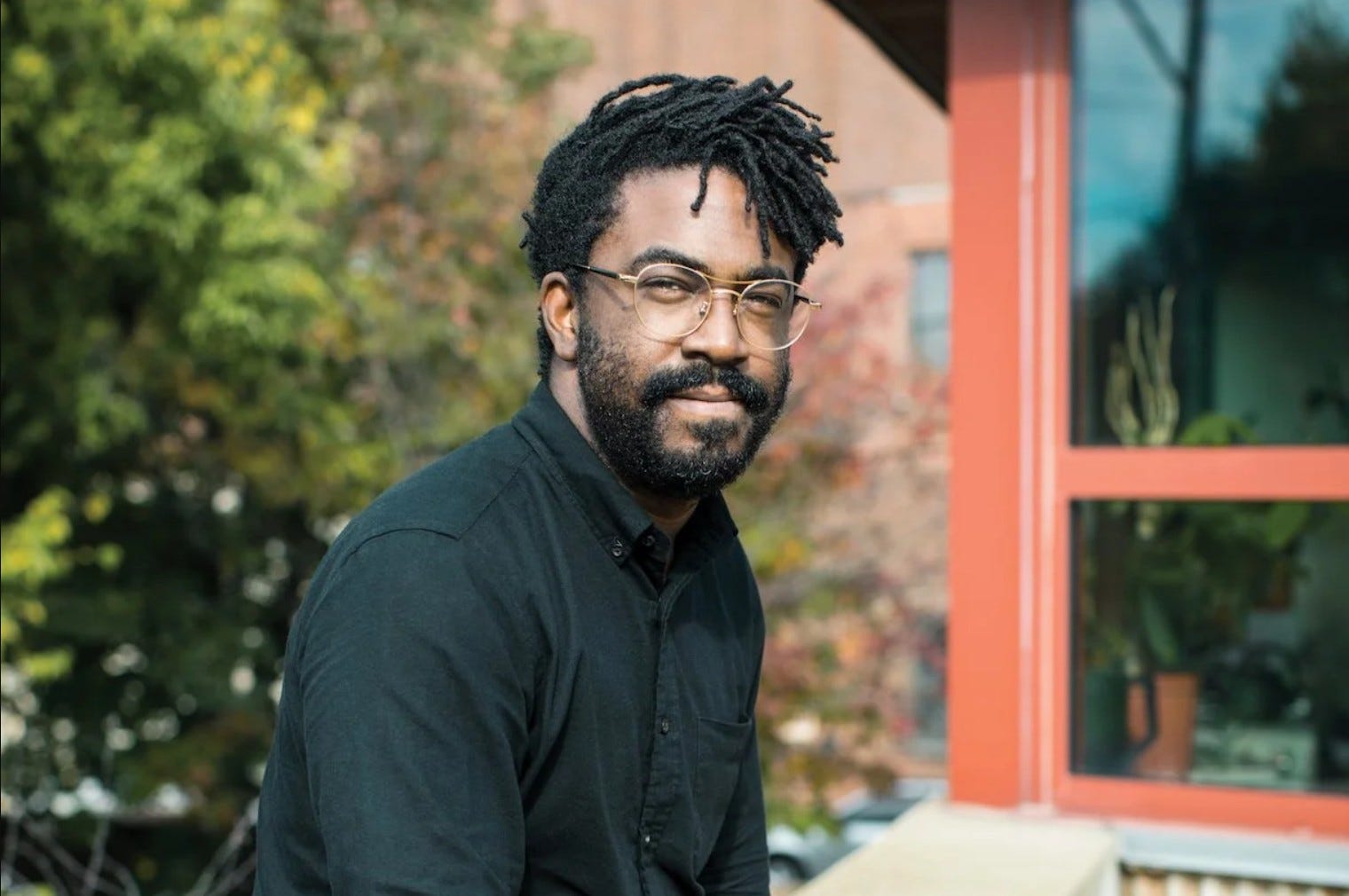
Darryl Holliday is a journalist, network-builder, community steward, and civic strategist committed to creating correctives for what’s not working in civic life. He’s the co-founder of City Bureau, the Documenters Network, Illustrated Press, and, most recently, News Futures and Commoner Company. I first met Darryl in late 2024, and he played an instrumental mentorship role in helping Richard Young and me organize and publish what became our “Invitation to a New Civic Future” letter.
Over the past year and a half, Darryl and I have jammed in countless group texts on the practices and principles and organizing models and metaphors that are needed for this next iteration of civic life. It was getting to the point where it felt like our conversations should leap from WhatsApp to Substack, so … here we are.
While we couldn’t capture 18 months of texts in a single Q&A, our conversation did not disappoint. We explored how Darryl’s work is trying to re-blur the lines between journalism and civic life. We got into the possibilities of the “do-ocracy” that is News Futures, and the actual structures and processes that underpin the work. We also had the chance to riff on what it takes to build a “compostable organization” that can release its assets back into the shared commons.
Darryl’s a humble, low-key dude, but beneath that humility is a wellspring of wisdom, and this Q&A is just a taster. So, if Darryl’s work and words pique your interest, check out his current projects with News Futures and Commoner, and follow along with him on his personal site and social medias. But, for now, consider giving the full interview a read below — I don’t think you’ll regret it.
- Sam
You’ve done a lot by the ripe old age of 40 — from co-founding and leading City Bureau, to launching the Documenters Network, to, most recently, serving as the Lead Steward of News Futures and half of Commoner’s founding team. How would you begin to describe the throughlines (or connective tissue, if you will) across this work?
I’ve long felt the need to create correctives to what I see in the traditional journalism space. City Bureau and Documenters, Invisible Institute, Illustrated Press, News Futures, Commoner — they all are different frameworks and ways of working that emerged from this desire to create correctives. What are the changes to this system that would preserve what’s good and useful about it? And what did not work about it?
That’s the basis of my work: To create correctives to what’s not working, and to establish the models and frameworks and networks necessary to actualize these correctives.
One corrective I keep returning to, for instance, is how journalism skills really are civic skills. Journalism institutions and newsrooms, as they’ve gotten more professional, have tended to hoard those skills — pulling them increasingly away from local hands and into private coffers.
Let’s hold for a minute on this thread of professionalization within journalism, and how some of your correctives — City Bureau, Documenters, and News Futures — are attempts to re-embed journalism into local communities. Can you speak to how you’re trying to re-blur the lines between journalism and civic life?
We’ve institutionalized something that wasn’t built to be institutionalized. The major newspapers were owned by rich people in the past — much as they are now — but it was a bit more tied to the ground. Today, we have all these systems and structures that continually remove local information systems from the local.
Part of this emerged because we created barriers to who could become a journalist. You used to not need a college degree to be a beat reporter. You would come in as a crime reporter — like I did at the start of my career — and you’d work your way up to being an editor, and eventually you were the one setting the agenda for the day. Now, we have these degreed programs — journalism schools that give out bachelor’s and master’s degrees — to help you prove you have the “qualifications” to be a journalist. These degree programs are functionally paywalls. You have to go to journalism school to learn how to do things that anyone needs to know in order to be tapped into what’s going on around them and to have a sense of agency and influence over their lives.
But there are also actual paywalls. News reporters will spend a year on a story, give you none of the underlying material, and then make you pay for it. That’s mostly public information. Just as with journalism schools, you’re putting things that are part of the commons — part of what we need to be a functioning society — behind these commercialized mechanisms that build the overall wealth of people like Jeff Bezos.
When people want to directly participate in their local information systems, they have few places to go, and it wasn’t always that way. There have been little incremental steps over the course of decades that have led to this entrenched, ossified, and removed system.
What we’re trying to do is re-blur the lines between journalism and civic life, and in so doing, between insiders and outsiders. Documenters follows that logic, as does City Bureau. News Futures is collectivizing the people who agree with those values, and asking: What can we do together? What does it look like to build a bigger constituency that is trying to reimagine civic information for a world where people are tired, and where people don’t feel their agency or their power?
That’s why I say journalism skills are civic skills. They are skills people need when they feel that urge to be a part of things, and they need the information to know how to do something about it.
So how did News Futures emerge in the first place, and what was it responding to?
News Futures used to be called the Future of Local News (FLN), and it began as a gathering. Sarah Alvarez, who is a great writer, editor, and journalist — and longtime friend and collaborator in this work — initially brought us together. We had both seen what was happening: This new crop of indie journalists and nonprofit newsroom leaders were developing and coalescing around different ideas. They were returning to community-first, local-first, participatory principles. So Sarah was just like, “Let’s pull together a small group of people to come to Detroit and figure out what this thing is.”
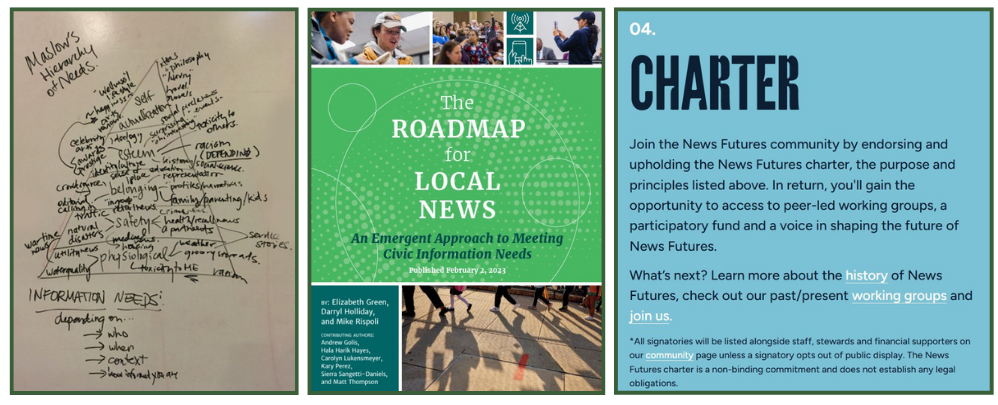
We started articulating a framework, the Hierarchy of Information Needs, for what we felt was distinct about what we were doing and what wasn’t represented in the zeitgeist at the time. Early on, we focused on how to sustain the models we built: City Bureau, Outlier Media, Resolve Philly. But, over time, it became more about: What do these individuals need who are increasingly seeing themselves as civic media makers? So we started imagining how we could create new systems, find new paths of funding, and build a new field.
How did you go from this initial insight and core group, to the 800-plus member network News Futures is today?
This involved growing, with intention. After that first gathering, we created a plus-one system, where we allowed the people who were in it to invite one new person. Then the question was: Is this exclusive? I don’t think exclusion is necessarily a problem, especially if we’re pushing against a dominant structure. We should want a period of exclusion where we ask: What is it that we’re doing that’s different? How are we saying who we are? Does this person actually fit? But, eventually, we knew it was a thing. We were seeing our language everywhere and constantly showing up to these conferences where our organizations were being showcased. It wasn’t a theoretical practice anymore; it had the makings of an actual movement.
What did that movement require? We needed more people, for one. We also needed to begin figuring out how to structure the engine of the work. How do we move people into the system? What do we actually produce? How do people work together? We use the word do-ocracy. It’s the idea that, if you see a thing that needs to be done, you can step up and do it and rally people internally to do it with you.
We spent the last six years creating the systems that enable that kind of doing on the individual level, especially in ways that people’s organizations tend to silo. There are things that motivate you as a person that your organization may not account for. But at News Futures, you wear your own hat, and there is this wider group of people who know your experience. On the scale of shared understanding, you can begin at 10 — not zero — and what you can do in that context is far more expansive.
You started speaking to the “do-ocracy” element of your work. My sense is y’all were particularly intentional in your design choices tied to how governance works and how you think about roles. Can you speak a bit to the particular “how” of News Futures’ work, and why you made the design choices you did?
Some of figuring this out was organic. I don’t consider myself a governance expert even now, but I certainly wasn’t an expert in collective and consensus processes then. I credit people like Kate Sassoon — we call her Sassy, she’s a straight-up genius at this stuff — who helped us take the things that were working well organically, and, over time, put them into structures that have a deeper reservoir of research and practice.
Sassy introduced the decision-making matrix. It’s essentially a spreadsheet of exactly how categorical decisions are made in News Futures. Some of them are autocratic on purpose: We’re agreeing that, for certain things, the person who is elected to this role needs to be able to decide on their own. But then there are other decisions where it’s always going to be delegative, and others where it’s always going to be based on a supermajority. Making that visible provided clarity for when and how we made joint decisions.
We also have the Gardening Club, an elected body we instituted to support the team and hold News Futures’ highest values at the front of their minds. They function somewhat like a board. But, really, they are meant to represent and reflect the needs and wishes of the community, and they are tasked with tying those needs and wishes into the long-term direction that we’ve set.
I credit Cassie Haynes for the “Gardening Club” name. We could have called it a committee or board. But she challenged us to ask: What does this body actually intend to do? Our answer was: garden. We are tending to the thing that we are cultivating, that we all intend to harvest together. You can find the language of gardening and natural processes everywhere in News Futures.
Beyond the Gardening Club, the Working Groups have become the core of our work. The ideas that emerge at our annual convening are exactly what the working groups drive toward. That’s been the case all along. We used to have these “open space” gatherings, and the ideas that surfaced and were clearly seen as viable and popular across the group became the things that we would collectively fund and work on. The people who had those ideas would either become stewards or find co-stewards to help them run that thing. It’s peer-derived, peer-led, surfaced through a central fund, and essential to how we work.
These are all systems that emerged both organically and with serious help from folks who know the cooperative world. These days, News Futures is the only org in the local news space that is exclusively dedicated to field-building. We don’t focus on publishing or grant-making; we focus on creating relationships between the people who make that stuff work.
Most people haven’t been formed in participatory, self-governing institutions because these institutions have mostly atrophied. Instead, our generation has come up in more transactional, consumptive ones. It sounds like News Futures is rebuilding that kind of formative institution, and I’d guess the people participating in it are being changed by practicing self-governance. Have you seen any of this type of small “d” democratic formation happen at the level of your own membership?
I’m a big fan of sci-fi, and ark ship narratives in particular. For the journalists that see the decline of this dominant system of traditional journalism coupled with the rise of this emergent system of civic information, one of our tasks is to put journalism into places that are more tied to the ground and more explicitly dedicated to material outcomes in people’s lives. We’re finding new worlds for local news — because we see the value journalists can provide when they’re thinking less about “content” and more about community benefits. Journalism is very conducive to producing facilitators and conveners and design thinkers, and the industry tends to use those skills to, instead, produce “stories.” In this new world — come on — there is so much fucking content. There is no amount of content you produce that is going to improve our society.
Except for this interview.
Yeah, this one is different, and we know that.
Back to the point, though: Most journalists want to change the world in some way, and that’s why they get into journalism. They believe in people, they love people, and they want to know people and understand people. And so they naturally want to convene people, and they want to facilitate conversations, and they want to create events and sessions that get people moving and thinking. Those are the new skillsets for journalists, and the future skillsets that we need in our communities.
All the people in News Futures are creating organizations and models and products and ideas that understand this need (and opportunity). Some groups literally do nothing but these various forms of convening and facilitating and answering people’s direct questions and investigating things, but on the human scale that our friends at the Relational Tech Project talk about — of one to ten or one to a hundred, not one to a billion. Other members are building systems and processes and models that enable people to practice self-governance and peer governance. This is interstitial work that people like Jenn Brandel, who is a long-time member of News Futures, have been on for well over a decade.
News Futures members are being formed at multiple levels — by working alongside fellow members as part of News Futures, and through their direct experimental work in communities.
Concepts like “self-governance” and “do-ocracy” and all this stuff are often easier said than done. What’s worked well — and less well — about News Futures’ approach to date?
News Futures has always taken the position that we’re going to focus on our constituency. We aren’t trying to grow it indefinitely, and that just means that we can focus on the people who come in and the word-of-mouth factor. Almost everyone who comes into News Futures has heard about it from someone who invited them there. We want the right people in the room, and the right people are the people who want to be there and who feel connected to the space.
We’ve also remained intentional about basing membership on the individual — not their organization — and tamping down instances where the line gets crossed. This individual-level membership enables the cross-sector nexus that we want to create. There’s an entropy within the journalism space; a lot of it is because we distance ourselves from other people and sectors. So part of our corrective is to say: Let’s reintegrate. There are people working in adjacent spaces who are valuable, valid, and viable information producers and distributors. Our individual-level membership helps create the spaces where we’re jamming with them and coordinating together.
On the other hand, the tension in our size is becoming more real. Our approach works because we are not a shark constantly swimming around looking for food in order to grow. That means our budget is relatively small, but, even so, we’re outgrowing our fiscal sponsorship model. We need to look towards independence, but I don’t want to become yet another nonprofit. So, we’re working with a team of lawyers to figure out a tax status that will align with our governance model and the way we work, and won’t put us into a box that will eventually force News Futures to compete with the organizations in our ecosystem.
The Gardening Club can also be difficult. It’s hard to be in the position of caring deeply about the community and of making strategic decisions, but also knowing when to step back. A lot of us are friends. We have seen each other grow up. We have matured together, and we all see a similar goal, but there are real tensions. They can be productive, but these are relationships that we’re talking about. We’re not an organization. We’re a band of people who love working together, see a common vision together, and are engaged in a peer governance process together. That comes with all kinds of beautiful things, but it can also be tense because we have to learn to be a mini democracy together.
You have a decade-plus of experimentation with these “correctives” like News Futures and City Bureau under your belt. Do you have any hunches on where this work goes next?
These days, I am always willing to put energy into my kid where I used to put it into work. In this beautiful little period where she’s exploding with words and personality and ideas, I’ll put down my work in a heartbeat to think about where we’re gonna go fly our kite next.
That said, I am thinking about where this work can go. All these things — City Bureau, News Futures, Commoner Company — they are one 15-year thread. Now, especially with the Corporation for Public Broadcasting (CPB) rescission, the question is: How are we going to reimagine public media, and re-learn how to build the movements and alliances that create real public information policy — the kind that won and built institutions like the CPB to begin with? We need to put the public back into public media. What is the version of this that holds true to what journalism should be, but also brings it back to the people who need it most?
The timing is ripe. We have this emergent, energized force of civic media practitioners who are thinking about new alliances. We could have a powerful new way of conceiving public media and information if we were to figure out how to work together and how to broaden the tent of what counts as public media. We have the makings of a sea change. We have a powerhouse of talent, of leadership, of new models, and of older traditional infrastructure. To me, that’s the edge.
Earlier, you described how so much of News Futures language and approach draws inspiration from natural processes. How do you think about applying these natural metaphors when you consider the life cycle of News Futures, itself?
News Futures is open source. Anyone here can use our assets for non-commercial purposes that are aligned with our charter and build the field. Now that we have these assets, this idea of a compostable organization — one that can release all of them back into the world — is really appealing to me. That involves intentionally not putting things behind paywalls, and not feeling the need to own every idea that emerges.
I briefly touched on entropy earlier, and I see a lot of journalism industry groups where entropy has settled in. They’ve grown so big, and so many people’s healthcare and jobs are tied to them, that all they’re able to do is try their best. But then the applications to the fellowship start to dwindle, and the attendance at the events begins to dwindle, and you just slowly become this little dwarf star. You end up with hundreds of these intermediary organizations that only exist because they are still being propped up by philanthropy.
I want to be able to build a functional, structured, efficient, and effective thing that can release its energies and assets back into the field when the time is right. I don’t want to dwindle. I want to go fucking supernova. I want to release everything back out at its peak power, not wait until the lights go dim.
These are strategic and operational considerations, and they run counter to the typical approach to building organizations. We need to understand the makeup of our work so that, when it’s time to release our assets back into the world, we’re actually able to do so, rather than finding ourselves caught in this trap of having to preserve and protect what we’ve been building.
I keep returning to this tension between machine logic and ecological logic as the organizing frame beneath much of what we’ve been discussing. Machine logic builds for immortality — untethered from any natural life cycle — while ecological logic assumes we’re embedded within the natural processes of life, death and composting included.
I see a lot of that natural logic. I’m standing in my garden right now. Earlier this morning, I moved my mint closer to my tomatoes because I read that keeping the mint close to tomatoes reduces the number of aphids and other bugs that are hanging around. I’m about to pull a runner from my strawberry plant and plant some new strawberries. These are all compost-adjacent ideas. How do these things help each other just by co-existing?
Once this life cycle of my basil plant is done, I am going to compost it, and that soil is going to be extremely fertile, and I’m going to use it for my cucumber plant. But that takes commitment to a certain kind of durability, and also a commitment to letting go and not holding it too tightly. It takes a commitment to doing what is good for the garden and not any individual plant.
When I sit in my garden, I feel good, right? And when I think about News Futures as compostable, I feel good. And when I think about bringing people together in our network and letting them do whatever they want with the stuff that they create together, I feel good about that. And so there’s a certain vibe: Does it feel right? Does it feel good? Do people agree it feels good? Let’s do that.
I really love this thread of blurring the lines between journalism and civic engagement, giving everyone the skills to be a journalist. I think Esther Woj said something like “journalism is applied critical thinking” and that seems to be the most essential skill set of our time right now.